Wireless Protocols in Home Automation: Wi-Fi, Bluetooth, Zigbee and Thread
Introduction
Wireless protocols are a fundamental part of modern home automation. Although wired solutions remain the preferred option when maximum reliability is required, it is not always possible or economically viable to run cables to every device.
In these cases, wireless technologies make it possible to add sensors, switches, actuators, and other devices without construction work or modifications to the existing installation.
As a trade-off, wireless communications are more susceptible to interference and depend on signal coverage quality. Even so, modern protocols have evolved significantly and, when implemented correctly, provide more than enough reliability for most residential applications.
The most commonly used frequency bands in home automation are:
- 800–900 MHz, usually 868 MHz in Europe and 908 MHz in the United States.
- 2.4 GHz, available practically worldwide.
In general, lower frequencies offer greater range and better wall penetration, while higher frequencies allow more data to be transmitted at the cost of reduced coverage.
There are also different network topologies. Some protocols operate using point-to-point links, others use star topologies, and others use mesh networks, where devices themselves cooperate to relay messages.
Wi-Fi
Wi-Fi is the best-known IP-based wireless technology and can be considered the wireless equivalent of Ethernet. It is also one of the most accessible options for people starting in home automation.
Almost every home already has a Wi-Fi network, it does not require dedicated coordinators or gateways, and there is a huge range of compatible devices at very affordable prices. For this reason, many home automation installations start using Wi-Fi exclusively, even if it is not the ideal protocol for home automation.
Although modern Wi-Fi networks also use the 5 GHz and 6 GHz bands, in home automation the 2.4 GHz band is still the most commonly used due to its greater range and better penetration through walls and ceilings.
For this reason, it is often advisable to have a dedicated 2.4 GHz network for IoT devices, separated as much as possible from the regular traffic of computers, phones, and multimedia devices.
Wi-Fi is optimized for very high speeds, far beyond what most home automation devices require. This advantage comes at a cost: power consumption is considerably higher than in other technologies specifically designed for IoT.
In addition, Wi-Fi devices usually take longer to reconnect after waking up from sleep mode, making them less suitable for battery-powered sensors that are expected to respond immediately.
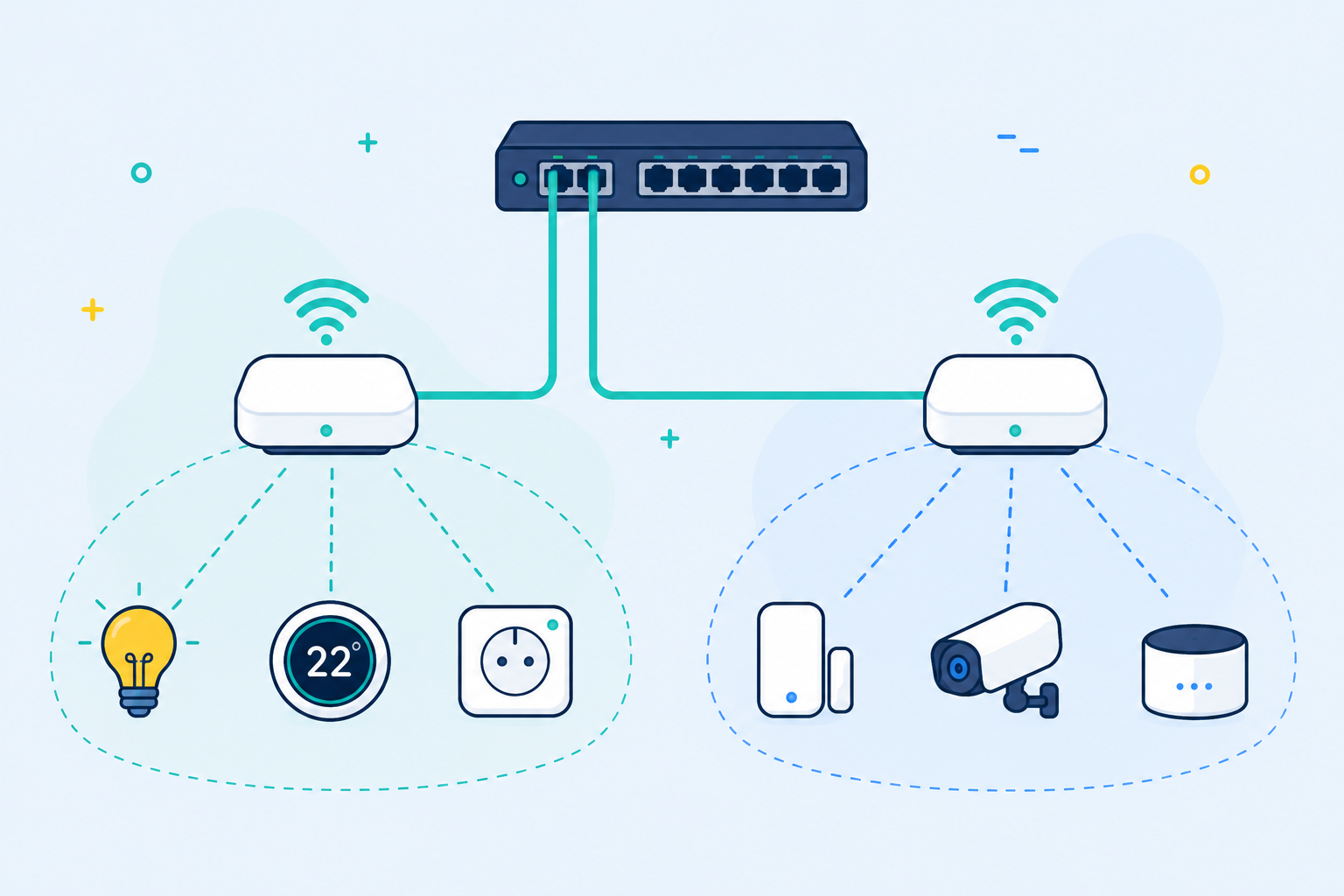
The typical topology is a star. All devices must communicate directly with a Wi-Fi access point, which can eventually saturate the network when the number of connected devices becomes large and the access point is not of good quality.
For this reason, in a home it is advisable to deploy multiple access points strategically distributed to guarantee proper coverage. Relying solely on the ISP router often results in poor coverage areas and stability issues.
In general, Wi-Fi is not a recommended protocol for battery-powered home automation devices. Its higher power consumption requires larger batteries or accepting shorter battery life. In addition, many Wi-Fi devices use more aggressive sleep modes to save energy, which often translates into longer response times when reconnecting to the network. For small sensors and other low-power devices, mesh networking technologies usually provide better results.
Besides typical uses such as laptops, tablets, or smartphones, Wi-Fi is particularly suitable for:
- Surveillance cameras
- Video intercoms
- Control panels
- Connected appliances
- Home automation devices powered directly from the electrical mains
In general, Wi-Fi should be reserved for devices that need to transmit large amounts of data or for cases where no equivalent Ethernet- or Thread-based alternative exists.
Bluetooth Low Energy
Bluetooth Low Energy (BLE) is an evolution of Bluetooth designed for very low-power devices.
It also operates in the 2.4 GHz band but is optimized to minimize power consumption and allow battery-powered devices to run for years.
Unlike other home automation protocols, BLE is mainly intended for point-to-point communication between devices. For this reason, it is not usually used as the main home automation network in a house.
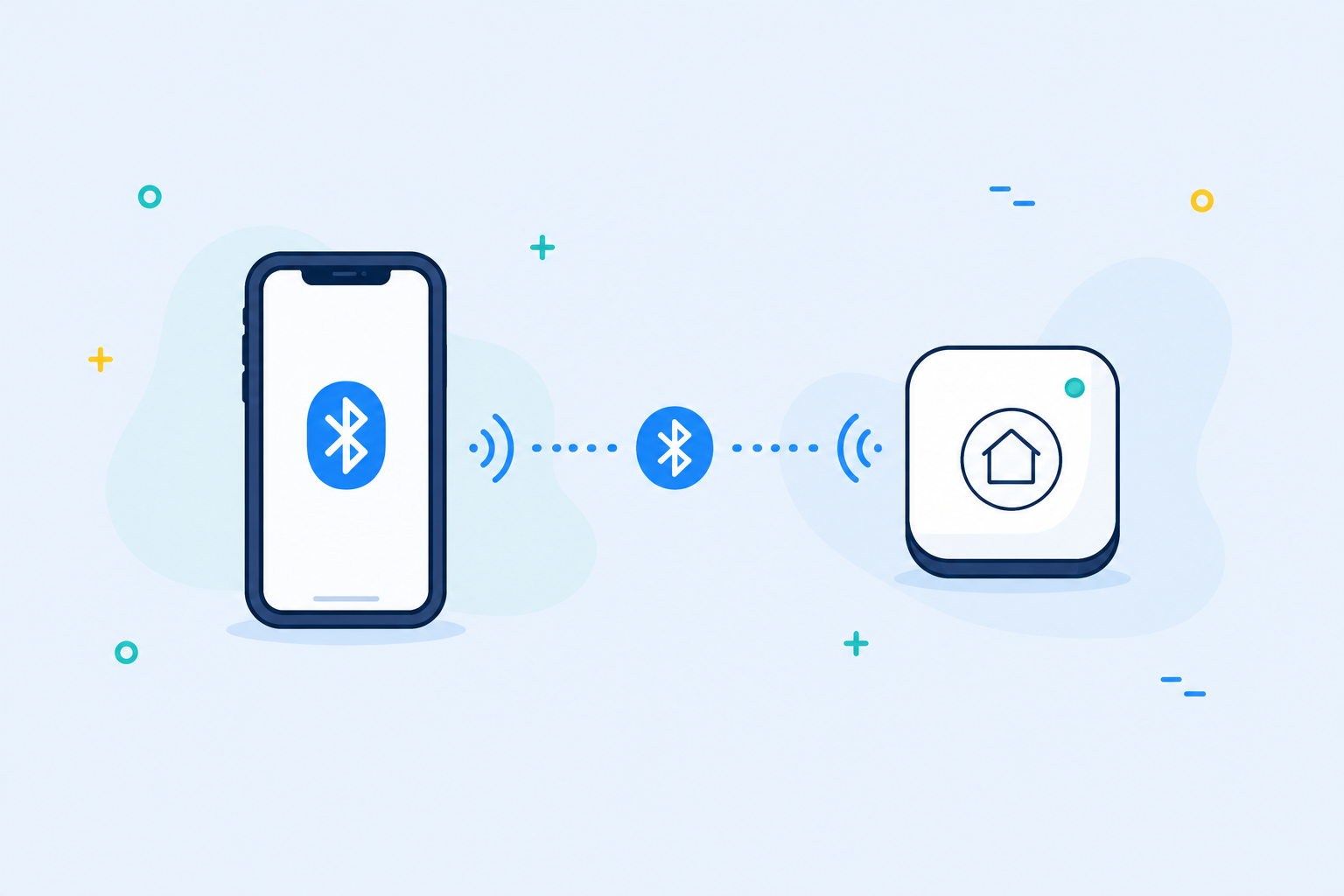
Its most common use is as an auxiliary technology for:
- Initial device setup
- Transferring Wi-Fi or Thread credentials
- Temporary connections from mobile phones
- Specific integrations from certain manufacturers
Virtually all modern Thread devices use Bluetooth LE during the initial setup process.
Mesh networks
Mesh networks are currently the most widely used solution for wireless sensors and actuators.
In this type of network, devices can relay messages between each other, extending coverage and improving resilience against failures.
The main advantages compared to Wi-Fi are:
- Lower power consumption
- Faster response times when waking from sleep mode
- Greater robustness against individual failures
- Self-healing capabilities
- Less dependence on coverage from a single access point
Two types of devices are usually distinguished:
- Mains-powered nodes, which remain permanently active and help relay messages
- Battery-powered nodes, which spend most of their time sleeping to maximize battery life
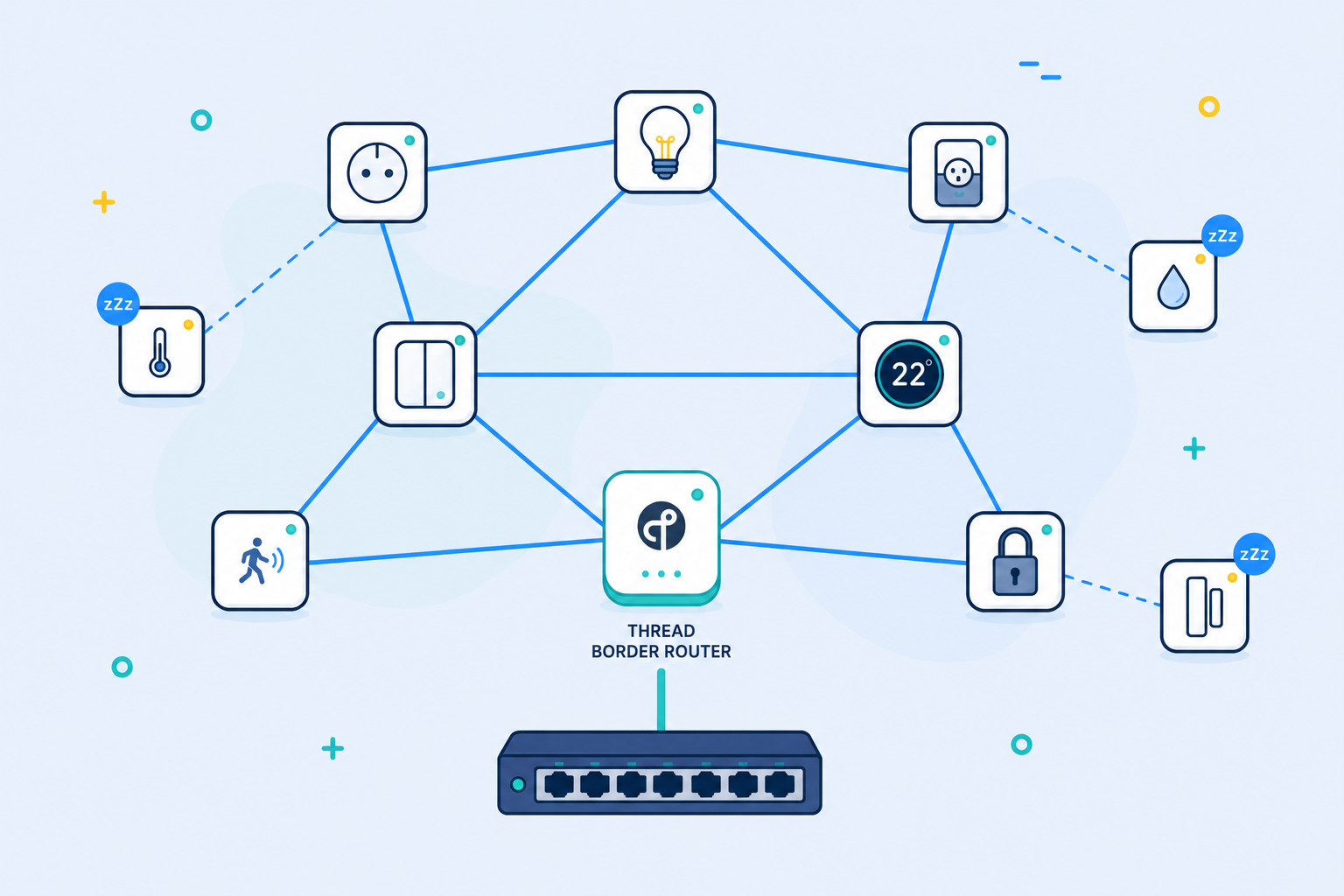
The more mains-powered devices there are, the better the network coverage and routing capacity.
Currently, there are mainly three mesh networking protocols on the market: Z-Wave, Zigbee, and Thread.
Z-Wave
Z-Wave was one of the first wireless technologies specifically designed for home automation. It uses sub-GHz bands, typically around 868 MHz in Europe and 908 MHz in the United States. This generally provides better range and better wall penetration than 2.4 GHz-based technologies.
Unlike Zigbee and Thread, Z-Wave uses its own radio technology and is not based on IEEE 802.15.4. It is an open standard and allows interoperability between devices from different manufacturers.
One of its historical strengths has been a stricter certification process than Zigbee, which generally translates into better compatibility between devices. However, its ecosystem is smaller, there is less product variety, and devices are usually more expensive.
Z-Wave is not IP-based and requires a central controller to manage the network. This controller represents a single point of failure and usually also acts as a gateway between the Z-Wave network and the rest of the home’s IP infrastructure.
Zigbee
Zigbee is currently one of the most widely adopted wireless technologies in home automation. It operates in the 2.4 GHz band and is based on IEEE 802.15.4.
Its maximum transmission speed is 250 kbit/s, more than sufficient for sensors, switches, actuators, and other home automation devices. Compared to Z-Wave, the range between devices is usually somewhat shorter due to the use of the 2.4 GHz band. However, in a properly designed home this difference rarely becomes a practical issue.
Like Z-Wave, Zigbee is not IP-based and requires a central coordinator to create and manage the network. All Zigbee devices depend on this coordinator to join the network and perform many management tasks, so it remains a single point of failure.
Its main advantage is the huge ecosystem currently available. There are hundreds of manufacturers and thousands of compatible devices, making it one of the technologies with the widest product variety on the market.
Thread
Thread is the most recent addition to the home automation ecosystem and is currently considered by many to be the natural successor to Zigbee. Like Zigbee, it uses the same IEEE 802.15.4 radio and operates in the 2.4 GHz band at speeds of up to 250 kbit/s.
The fundamental difference is that Thread is based on IPv6 using 6LoWPAN. This allows all Thread devices to be part of a standard IP network and greatly simplifies integration with other systems and protocols.
Another important difference is that Thread does not depend on a single coordinator. The network is managed in a distributed way, and any device with the appropriate credentials can fully participate in it.
To connect the Thread network to the rest of the IP infrastructure, one or more devices known as Thread Border Routers are required. Unlike Zigbee or Z-Wave controllers, multiple Border Routers can coexist within the same network, eliminating the single point of failure and increasing system resilience.
At present, the Thread ecosystem is still smaller than Zigbee’s, although it is growing rapidly thanks to the momentum of Matter and the support of much of the industry.
Other technologies
Many manufacturers also develop their own wireless protocols for specific use cases. These are usually designed to operate only within a specific ecosystem and are rarely used as a general home automation network.
KNX RF
KNX RF is the wireless version of the KNX ecosystem. It is not intended to compete directly with the previous technologies, but rather to provide a wireless alternative when you already have a wired KNX TP installation and need to add an extra device where running a cable is not possible.
It operates in the 868 MHz band and is fully integrated with the rest of the KNX ecosystem. Its use is usually limited to extensions or renovations of existing KNX TP installations and is rarely used as the main technology for an entire home.
Loxone Air
Loxone Air is a proprietary technology used exclusively within the Loxone ecosystem. Its goal is similar to KNX RF: to allow wireless devices to be added to extend existing wired Loxone installations.
Although it shares some underlying technologies with other modern protocols (like Thread, it is based on IEEE 802.15.4 and 6LoWPAN), it is a completely closed solution and incompatible with other ecosystems.
Comparison of wireless protocols
| Protocol | Frequency | Speed | Topology | IP-based | Power consumption |
|---|---|---|---|---|---|
| Wi-Fi | 2.4/5/6 GHz | Very high | Star | Yes (IPv6/IPv4) | High |
| Bluetooth LE | 2.4 GHz | 125 kbps–2 Mbps | Point-to-point | No | Very low |
| Z-Wave | 800–900 MHz | 9.6–100 kbps | Mesh | No | Very low |
| Zigbee | 2.4 GHz | 250 kbps | Mesh | No | Very low |
| Thread | 2.4 GHz | 250 kbps | Mesh | Yes (IPv6) | Very low |
| KNX RF | 800–900 MHz | 16.4 kbps | Limited | No | Low |
| Loxone Air | 800–900 MHz | 40–250 kbps | Mesh | No | Low |
Conclusions
Our general recommendation for a modern home is to deploy a solid IP-based infrastructure combining Wi-Fi and Thread. Both technologies are complementary and serve different roles within a wireless installation.
Whenever possible, we recommend prioritizing Thread when choosing sensors, switches, actuators, and other home automation devices. Its low power consumption, distributed IPv6-based architecture, and self-healing network capabilities make it particularly suitable for these applications. In addition, the more permanently powered Thread devices there are in the installation, the better the network coverage and overall robustness will be.
Wi-Fi should mainly be reserved for devices that genuinely need to transmit large amounts of data and cannot be wired, such as laptops, tablets, or smartphones. Although Wi-Fi is an excellent technology for these applications, it is not the most efficient option for most home automation devices. In general, the more Wi-Fi devices connected to the network, the greater the load on access points and the harder it becomes to maintain a stable and efficient wireless network.
In short: build a good Wi-Fi network, but prioritize Thread whenever possible and use Wi-Fi devices only when there is no better alternative.
That said, Zigbee and Z-Wave remain perfectly valid technologies and, in many cases, still offer a wider variety of devices and greater maturity. At present, they may still be the best option for certain use cases. However, the direction the industry appears to be taking clearly points toward Thread as the foundation for future wireless home automation installations.